

Writing
Click the audio play button to hear the entire article!!!
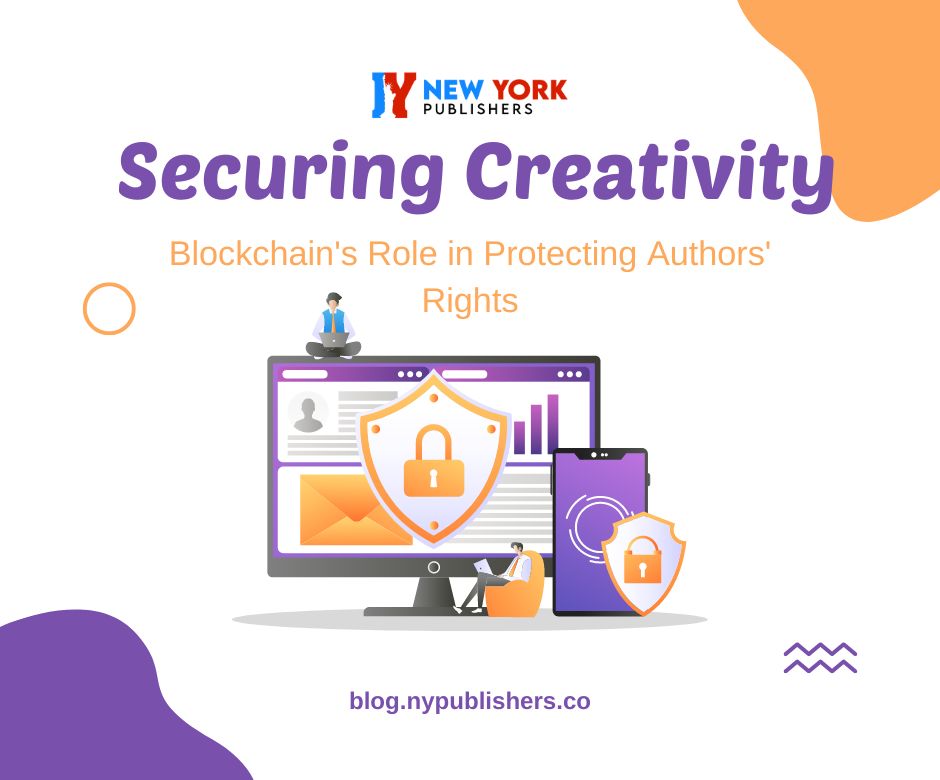
Protecting authors’ rights and enabling creators to earn fair compensation for their creative works is critical. With the rise of digital content distribution, ensuring that authors retain control and receive royalties for their work poses significant challenges.
Blockchain technology offers a promising approach to securing creative works and automating rights management. Blockchains provide immutable ledgers for registering rights and smart contracts to encode permissions and royalties into digital assets. This enables direct payments to creators and gives authors more control over their content.
This article will explore how blockchain technology can empower authors, musicians, and other creators by improving their ability to track rights, get paid, and maintain ownership over their creative work in the digital economy.
The book publishers in New York will examine key issues authors face today and provide an overview of how blockchains work. We will also discuss specific Blockchain implementations for Authors that help secure and monetize their content.
1. Copyright Issues for Authors
Authors face significant challenges when it comes to protecting and enforcing their copyrights. Copyright infringement has become rampant with the rise of the internet and digital content.
One major issue is piracy sites illegally distributing books, articles, songs, and other content without permission. Authors have difficulty getting infringing content taken down, as these sites are elusive and difficult to trace.
Plagiarism is another ongoing problem, made easier by the ability to quickly copy and paste content. Articles and blog posts often use excerpts from books without attribution.
The burden is on authors to continuously scour the internet to identify infringements and send takedown notices. This is an impossible task with many piracy sites and the ease of online copying. Authors lack the resources to constantly police their copyrights.
Overall, authors have minimal recourse and receive little compensation when pirated, plagiarized, or used without permission. New technology-based solutions are needed to help secure authors’ creative work and enable them to reap the benefits of their copyrights.
2. How Blockchain Works
Blockchain is a decentralized digital ledger that records transactions in a verifiable and permanent way. Unlike traditional ledgers, which are held by a central authority like a bank, blockchain ledgers are distributed across a network of computers.
When a new transaction occurs, it is broadcast to the network and grouped with other recent transactions into a block. This block is validated through cryptography and attached to the existing chain of previous blocks, creating a permanent and unalterable record.
All participants in the blockchain network have a copy of this ledger. This way, there is no single point of failure. This decentralization and distribution provides transparency, as anyone can view the blocks and transactions.
Blockchain’s decentralized structure also makes the data immutable and tamper-proof. Once recorded, transactions cannot be altered retroactively without altering all subsequent blocks. This provides security and traceability.
3. Smart Contracts Automate Rights Management
Smart contracts on the blockchain allow creators to set usage terms and conditions that get automatically enforced. These self-executing agreements can specify how a creative work may be used, shared, modified, or distributed.
The smart contract code contains predetermined rules, so if a third party attempts to use the work outside the permitted ways, the smart contract blocks it.
For example, an author could program a smart contract to limit the number of copies that can be made of an ebook. Or specify a fee that must be paid in cryptocurrency each time the book gets shared or downloaded. The smart contract would then automatically collect those micropayments and send them to the author. No middleman or centralized authority is needed.
Smart contracts also enable dynamic pricing models. An author could initially set high fees when a new book launches, then gradually decrease the price. The contract terms are transparent and immutable, removing the need for ongoing negotiations.
Smart contracts give creators more control by automating Blockchain for Authors’ rights. Blockchain technology ensures the rules get applied, even if the work spreads far and wide across the internet.
4. Blockchain Rights and Royalties Management
Blockchain for Authors allows for automated rights management and royalties for creative works. Platforms have emerged that facilitate content licensing using smart contracts on the blockchain. This enables seamless and transparent content usage licensing from creators to consumers.
Some key benefits of blockchain rights and royalty management include:
-
Automated licensing via smart contracts.
Licensing terms like permissions, restrictions, and pricing can be programmed into smart contracts. This removes paperwork and manual processes.
-
Accurate royalty distribution.
Smart contracts can automatically distribute royalty payments to creators as their work is used. This Blockchain for Authors eliminates delays and opacity in royalty reporting.
-
Micropayments at scale.
Small transaction amounts can be sent instantly to creators whenever their work is accessed or used. This granular monetization wasn’t feasible before Blockchain for Authors.
-
Transparent record of ownership.
The blockchain ledger provides a permanent and shared record of rights ownership that can prevent unauthorized use.
Blockchain for Authors’ royalty platforms reduces friction and overhead in licensing creative works. They streamline the compensation process for creators by automating royalty calculation and payment.
5. Blockchain Copyright Registration
Blockchain technology offers authors a decentralized way to register and verify the copyright of their creative works. Traditionally, authors register copyrights through centralized databases like the U.S. Copyright Office. However, this process can be tedious and expensive. Blockchain allows authors to easily timestamp their work on an immutable ledger.
Here’s how it works:
- The author uploads a digital imprint of their work – a text file, image, song file, etc.
- The imprint is encoded into a hash string – a unique fingerprint that identifies the work.
- The hash is recorded on the blockchain along with a timestamp. This establishes evidence that the author possessed the work at the recorded date and time.
- The timestamped record serves as a verifiable copyright certificate. Authors can reference the entry to prove ownership and creation date.
- The decentralized ledger also provides a persistent public record. Timestamp details remain intact even if the original work is modified.
Blockchain registration offers authors broader copyright protection. Records can’t be forged or manipulated. Authors also avoid registration fees. Overall, Blockchain for Authors establishes irrefutable proof of authorship and content ownership.
6. Micropayments for Content
Blockchain technology allows for micropayments, enabling automated small payments each time someone accesses a creative work. This provides an alternative monetization model for authors compared to the traditional approach of selling books or ebooks.
With blockchain, tiny, frictionless payments can be made each time someone reads a chapter, article, or blog post. These micropayments are handled seamlessly behind the scenes through smart contracts. Readers simply pay a small fee in cryptocurrency to unlock access to the content.
For creators, getting paid for each access or view can add to meaningful revenue streams from their work. Rather than relying solely on bulk payments from book advances or royalties, authors can incrementally monetize their writing through an ongoing trickle of micropayments.
7. Limitations and Challenges
Although blockchain technology offers promising solutions for securing authors’ rights, mainstream adoption faces some key limitations and challenges:
-
Scalability issues:
Blockchain for Authors like Ethereum can currently process only 10-20 transactions per second, far below the volume needed to put the world’s creative works on the chain. Blockchain-based rights management may only work for niche use cases without major scalability improvements.
-
Energy consumption:
Proof-of-work blockchains like Bitcoin and Ethereum require vast computational power and electricity, raising sustainability concerns. Newer consensus models like proof-of-stake could alleviate this issue.
-
Lack of standards:
Competing blockchain platforms and rights management solutions create interoperability challenges. The lack of common standards also makes it harder to achieve mass adoption.
While blockchain technology brings groundbreaking possibilities for protecting authors’ rights, overcoming these adoption barriers will be key to realizing its full disruptive potential.
8. Implementations Improving Author Rights
Several real-world Blockchain for Authors projects are emerging to help authors protect and manage their rights better. Some examples include:
Publica:
This platform allows authors to publish and sell books directly to readers while encrypting the books’ content on the blockchain to establish authorship and prevent piracy. Publica has helped authors raise over $1 million in book pre-sales.
POE:
The Proof of Existence project uses blockchain to generate timestamps that establish copyright ownership. Authors can cryptographically prove ownership of writings.
Binded:
This startup offers copyright registration and licensing based on blockchain and has partnered with over 8,000 authors. Binded says the average user saves $800 in copyright fees.
Conclusion:
While there are regulation, scalability, and user experience challenges, Blockchain for Authors brings trust and automation to traditionally opaque media industries.
The future promises fairer rewards for creators, smoother fan experiences, and exciting new ways to unleash creativity. With so much potential, blockchain could become the missing link securing creativity in the digital age.